
Infrared thermography
Infrared thermography for the critical power path.
Level III thermographers scan your energized gear under load, from the utility switchgear to the busway over the racks. No outage, no shutdown window, and a report built for NFPA 70B, audits and insurers.
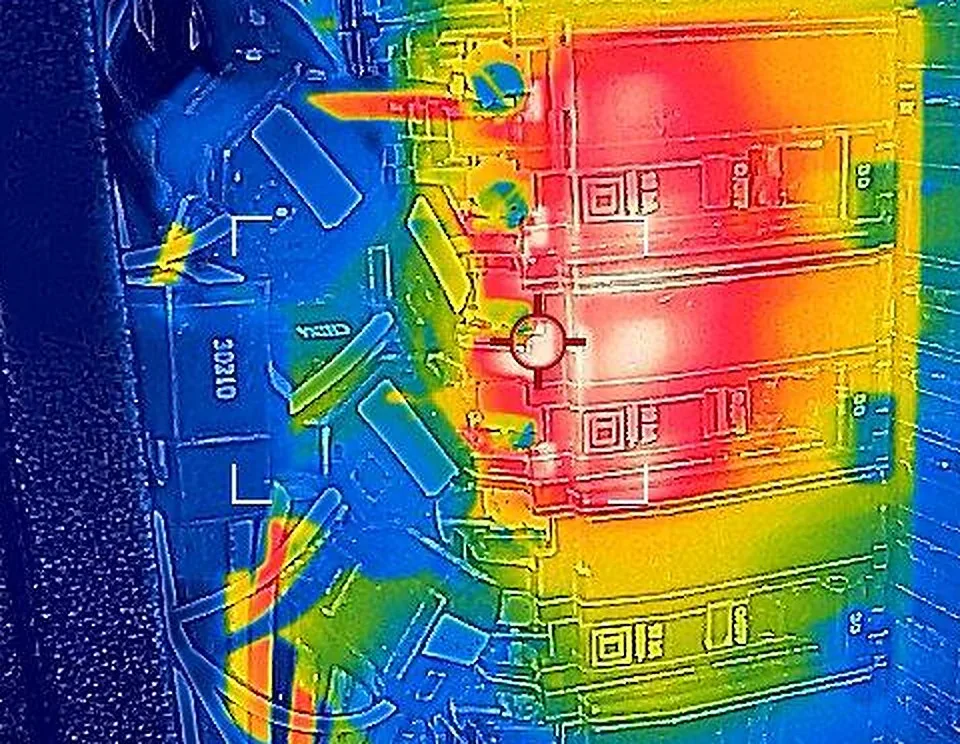 PDU PANEL · 142°F · CLASS 3
Why it matters
The failures that take down a data hall usually start as a few degrees.
Connections loosen with thermal cycling and vibration. Breakers and fuses degrade. Load shifts as tenants grow. All of it shows up as heat first, and infrared is the one inspection that sees it on live gear without touching it.
- 01
Catch it while it's a work order
A hot lug found on a scheduled visit is a planned repair under a MOP. The same lug found by failure is an incident.
- 02
Prove redundancy is real
A failing component on the B side quietly turns 2N into N. Scanning both paths shows whether your redundancy will hold.
- 03
Meet the standard
NFPA 70B (2026) calls for infrared at least every 12 months, and more often when condition warrants. Insurers and auditors ask for the report.
Scope
Every link in the chain, utility to rack.
Scope is built from your gear list or one-line. We scan what you choose, and recommend where a twice-yearly scan pays for itself.
Utility & distribution
- Medium-voltage switchgear
- Substation and pad-mount transformers
- Main switchboards and switchgear
- Automatic transfer switches
- Motor control centers
UPS & critical distribution
- UPS modules, input and output
- Battery cabinets and strings
- Static transfer switches
- PDUs and RPPs
- Overhead busway and tap-off boxes
Generation & cooling
- Generators and paralleling gear
- Load banks during testing
- Chillers, CRAH and CRAC units
- Pumps and motor drives (mechanical on request)
What you get
A report your team can act on and your auditor can file.
Every component listed
Not just the problems. You get a record of everything inspected, by location, so coverage is provable.
Thermal + visual images
Every finding has a paired infrared and daylight image so your electrician can find it fast.
Severity class 1–4
Classed by measured temperature rise against fixed thresholds, with a recommended action and priority.
NFPA 70B-ready format
Built for maintenance records, insurer submissions and customer audits. White-label available for partners.
Re-scan after repair
We verify the fix under load so the finding closes with proof, not a checkbox.
Year-over-year trending
Repeat scans compare each asset to its own history, so slow deterioration is visible before it becomes a finding.
- Of infrared thermography
- 30 yrs
- Of critical capacity scanned annually
- 1+ GW
- Components scanned
- 500,000+
- Infrared inspections
- 10,000+
- States scanned
- 45+
Related guides
Read before you scope it.
How often does a data center need an infrared scan? NFPA 70B intervals, explained
NFPA 70B (2026) calls for infrared at least every 12 months. Here's how data centers set intervals for UPS, PDU, STS and busway, and what auditors look for.
Read the guideArc flash studies in data centers: what's required and when they expire
NFPA 70E requires an arc flash risk assessment reviewed at least every five years, and NEC 110.16 requires labels. What triggers an update in a data center.
Read the guideFAQ
Infrared thermography: common questions
How often should a data center have an infrared scan?
At least once a year, and we recommend twice a year on critical distribution gear. NFPA 70B (2026 edition) calls for infrared thermography of electrical equipment at least every 12 months and shorter intervals when equipment condition warrants it. Most data center operators scan the full electrical path once a year. We recommend adding a mid-year scan of UPS, PDU, STS and busway, the gear closest to IT load.
Do you need an outage to scan our gear?
No. Infrared only works on energized equipment under load, so we scan live. Where covers must come off, a qualified electrician opens the gear under your MOP and NFPA 70E safe work practices. We can supply that electrician, or work alongside yours or your electrical contractor's.
Will you work under our MOP?
Yes. We work under your Method of Procedure, escort and change-control rules. If your site does not have one for infrared, we write a scan MOP for your review before the visit, covering scope, sequence, PPE, roles and back-out steps.
What equipment do you scan in a data center?
The full critical power path: medium-voltage and low-voltage switchgear, transformers, main switchboards, ATS and STS, UPS modules and battery cabinets, PDUs and RPPs, overhead busway and tap-off boxes, generators and paralleling gear. We also scan cooling equipment on request, because some of the most serious findings we see are on compressors and pumps.
What does the report include?
Every inspected component is listed by location, with thermal and visual images for every finding, the measured temperature rise, a severity class from 1 (normal) to 4 (immediate action), and a recommended corrective action. The report is formatted for NFPA 70B records, insurer submissions and audits. Partners can receive it under their own brand.
Can an infrared scan tell if a UPS battery is bad?
Partly. Infrared finds hot terminals, loose intercell connections and jars running warmer than their neighbors, which are early signs of trouble. It cannot measure capacity or remaining runtime. That's why we pair infrared with ohmic testing on every visit and capacity testing on cycle.
Next step
Tell us about your site.
Send a gear list, a one-line or just the address. We scope it with you, and you get a written scope and price, usually within one business day.